Running a small business often means wearing every hat—marketer, accountant, operations manager, and customer support lead. While large corporations deploy multi-million-dollar tech stacks, small teams can now achieve similar scale using generative and agentic artificial intelligence.
This operational framework breaks down how small businesses can evaluate, deploy, and govern AI tools responsibly—without overspending or compromising output quality.
1. High-Impact AI Tool Categories for Small Businesses
Rather than adopting tools haphazardly, categorize your AI stack by core operational functions:
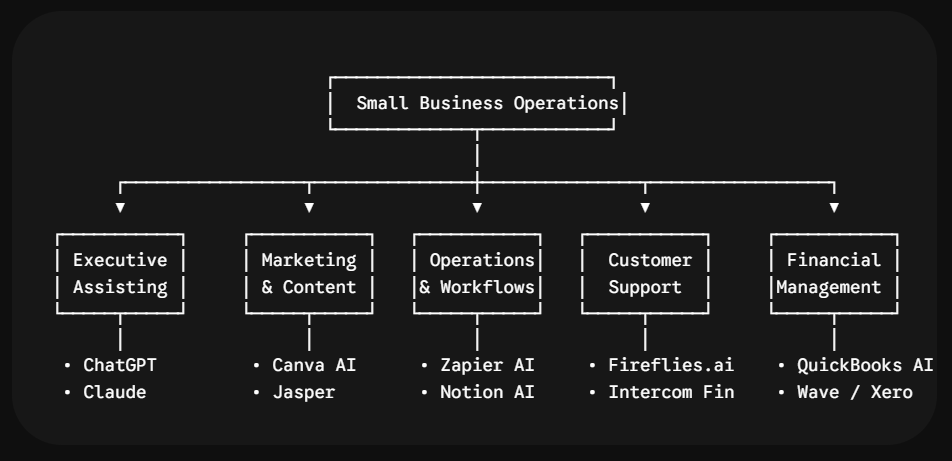
A. Executive Assistants & General Intelligence
- Primary Applications: Writing, strategic brainstorming, document analysis, and data interpretation.
- Core Tools: ChatGPT (OpenAI), Claude (Anthropic), Google Gemini.
- Real-World Application: Uploading annual profit-and-loss statements (PDF) into Claude or ChatGPT to extract key expense anomalies and summarize quarterly margins within minutes.
B. Content Creation & Marketing
- Primary Applications: Generating social copy, visual design, quick video drafts, and ad creative.
- Core Tools: Canva Magic Studio, Jasper, Descript, Adobe Firefly.
- Real-World Application: A local restaurant uses Canva Magic Studio to auto-generate monthly social promo graphics aligned with brand colors and fonts, cutting graphic design turnaround from days to under ten minutes.
C. Workflow Automation & Operations
- Primary Applications: App integration, automated lead routing, meeting transcriptions, and database management.
- Core Tools: Zapier (with built-in AI agents), Notion AI, Fireflies.ai.
- Real-World Application: Connecting web form leads through Zapier AI directly into a CRM, while triggering a personalized email draft and a Slack notification for the sales team.
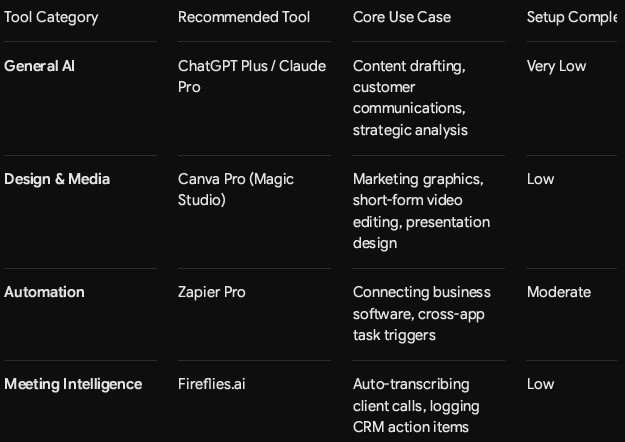
2. Comparing Core AI Tool Stacks
To build an efficient stack, evaluate tools on setup difficulty, primary business function, and cost:
3. Implementation Plan: 4-Week AI Rollout
Avoid “shiny object syndrome” by rolling out tools systematically:
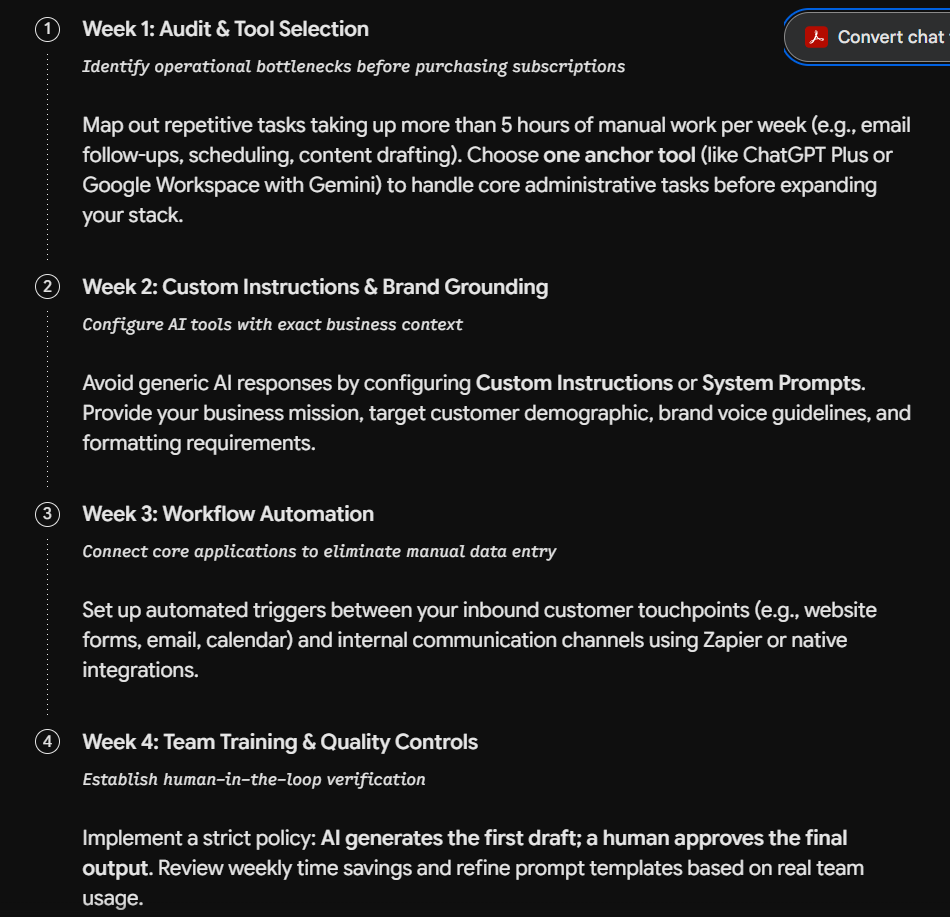
4. Operational Risk & Data Security Best Practices
While AI boosts efficiency, unmanaged adoption introduces real business risks. Maintain compliance and safeguard proprietary data with these guardrails:
- Data Privacy Settings: Turn off data-sharing toggles in consumer accounts (e.g., disable “Model Training” settings in OpenAI or Anthropic accounts) or subscribe to enterprise tier plans that explicitly guarantee non-training on customer data.
- PII Protection: Never input sensitive Personally Identifiable Information (PII)—such as customer credit card numbers, Social Security numbers, or raw patient records—into general public models.
- Hallucination Checks: Generative models can produce inaccurate facts or fake citations. Establish an operational rule that all figures, statistics, legal claims, and customer quotes must be verified against primary sources before publishing or sending.
5. Frequently Asked Questions (FAQ)
No. Modern business AI tools feature plain-English interfaces. If you can write an email, type a search prompt, or use a basic spreadsheet, you can operate tools like ChatGPT, Canva AI, and Zapier.
baseline stack for a small business (1–5 employees) typically ranges between $50 and $150 per month total. A solid starter budget covers:
One general AI assistant subscription ($20/mo)
One visual marketing tool ($15/mo)
One basic workflow automation plan ($20–$30/mo)
Generic output happens when prompts lack context. To fix this:
Provide examples of past successful copy in your prompt.
Specify tone constraints (e.g., “Professional, concise, friendly, avoiding buzzwords like ‘game-changer’ or ‘revolutionize'”).
Treat outputs as a 60–80% draft, requiring a human team member to review, edit, and add authentic local knowledge or brand experience before publishing.
AI works best as an efficiency multiplier rather than a human replacement. Small businesses using AI report that it frees up hours previously spent on manual data entry, transcriptions, and initial drafting—allowing small teams to focus on client relationships, high-level strategy, and revenue-generating work.