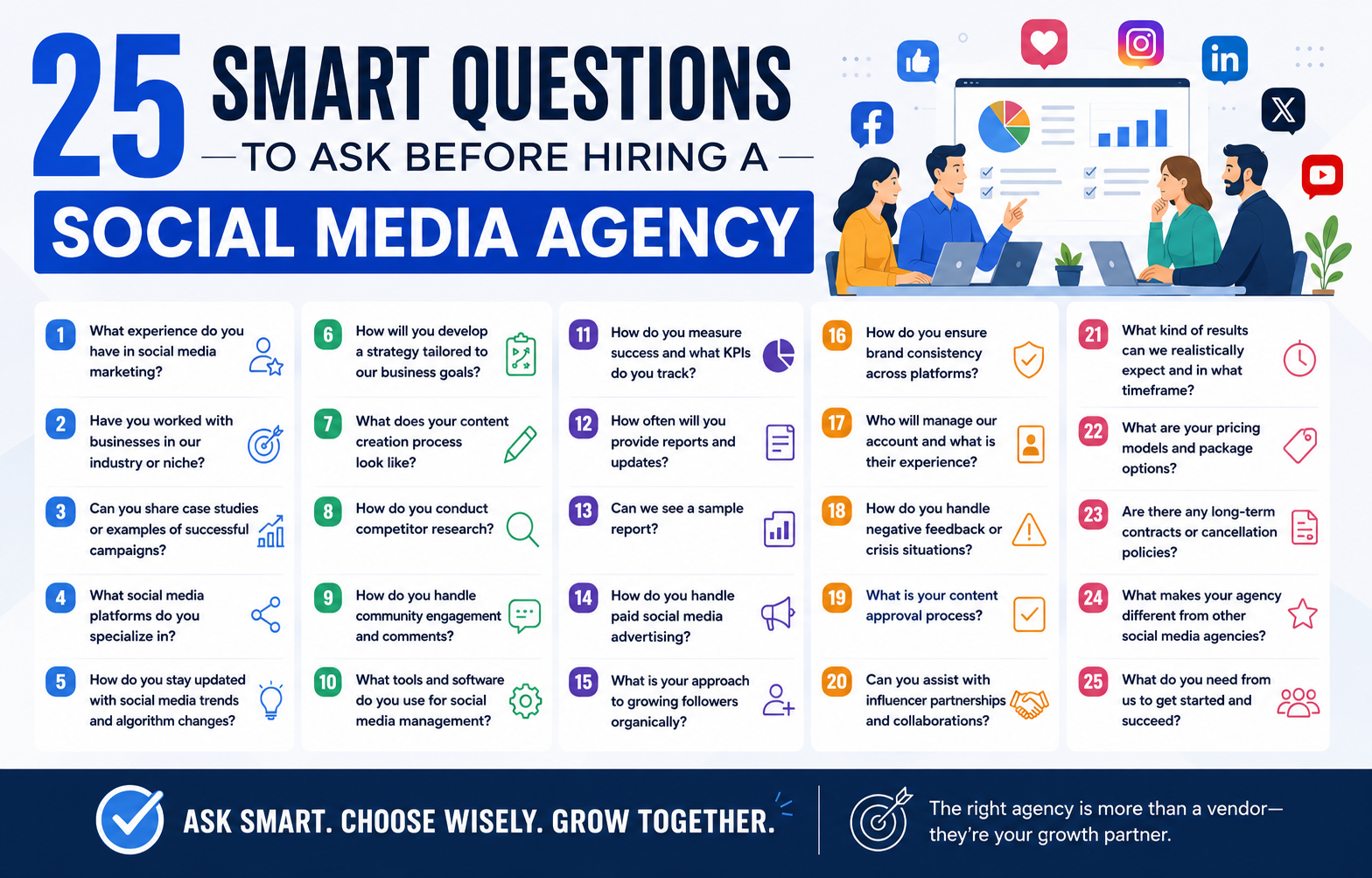
Businesses are investing more than ever in social media marketing, yet many still end up disappointed after hiring the wrong agency. Recent industry research shows that poor reporting, unclear expectations, and weak communication are among the biggest reasons businesses terminate agency contracts. One recent marketing survey even found that 75% of marketers who fired an agency blamed poor reporting and accountability.
The truth is simple: hiring a social media agency isn’t just about beautiful Instagram posts or viral TikTok videos. You’re choosing a long-term growth partner that will influence your brand reputation, customer relationships, lead generation, and revenue.
This guide will help you ask the 25 smartest questions before signing any contract so you avoid expensive mistakes and choose an agency that truly delivers results.
Why Asking the Right Questions Matters
Hiring a social media agency is similar to hiring a business partner. The wrong decision doesn’t simply waste money—it can damage your reputation, reduce customer trust, and delay your growth for months. Many agencies promise “more followers” or “viral content,” but followers alone rarely translate into sales. What truly matters is whether the agency understands your business objectives and has a proven process to achieve them.
Today’s social platforms evolve almost every week. Instagram changes its algorithm, TikTok introduces new discovery features, LinkedIn prioritizes different content formats, and Facebook advertising rules continue to shift. Because of this constant evolution, businesses need agencies that stay informed, adapt quickly, and explain their strategy transparently. Modern agencies should also discuss AI tools, content testing, analytics, and long-term brand building rather than relying on generic posting schedules.
The Cost of Choosing the Wrong Agency
Many business owners make decisions based solely on price. Unfortunately, the cheapest proposal often becomes the most expensive mistake. A low-cost agency may outsource work, recycle templates, buy fake followers, or produce content without understanding your customers. After six months, businesses usually discover that engagement has increased slightly but inquiries and revenue remain unchanged.
Choosing the wrong partner also wastes valuable time. Algorithms reward consistency, so changing agencies every few months often means restarting your strategy from scratch. Your audience notices inconsistent messaging, different visual styles, and changing brand voices. Recovery becomes difficult because rebuilding trust takes much longer than losing it. That’s why asking detailed questions before hiring is far more valuable than trying to fix problems later.
Questions About Business Goals
1. How will you define success for our business?
A professional agency never starts by talking about followers.
Instead, they ask about your goals:
- Brand awareness
- Website traffic
- Lead generation
- Sales
- Community building
- Customer support
If their success metrics don’t match yours, expect disappointment.
2. What KPIs will you measure every month?
Good agencies monitor metrics such as:
- Reach
- Engagement Rate
- Click-Through Rate
- Leads
- Conversion Rate
- Return on Ad Spend (ROAS)
- Customer Acquisition Cost
Avoid agencies that only report likes and impressions.
3. How long before we should expect measurable results?
No ethical agency guarantees overnight success.
Instead, they explain realistic timelines.
| Goal | Typical Timeline |
|---|---|
| Engagement Growth | 1–3 Months |
| Organic Reach Improvement | 2–4 Months |
| Lead Generation | 3–6 Months |
| Brand Authority | 6–12 Months |
Any agency promising thousands of followers within weeks should raise immediate concerns.
4. What industries have you worked with?
Experience matters.
An agency specializing in restaurants may struggle with SaaS, healthcare, finance, or legal services.
Ask for:
- Similar businesses
- Similar target audiences
- Similar budgets
- Similar campaign objectives
Case studies should demonstrate measurable outcomes rather than simply showcasing attractive graphics.
5. Can you show verified case studies?
Don’t accept screenshots alone.
Request:
- Before-and-after analytics
- Revenue improvements
- Engagement growth
- Lead generation numbers
- Client testimonials
- References you can actually contact
Professional agencies are usually happy to discuss real projects while respecting client confidentiality.
6. Who Will Actually Manage Our Account?
One of the biggest surprises businesses face is discovering that the person who impressed them during the sales meeting disappears after the contract is signed. Instead, the day-to-day work is handed over to a junior executive with limited experience. That doesn’t necessarily mean poor service, but you deserve to know exactly who will be responsible for your brand. Social media requires quick thinking, creativity, customer service skills, and an understanding of your industry. If the agency rotates staff frequently, your campaigns may lose consistency and momentum.
Ask whether you’ll have a dedicated account manager, content strategist, graphic designer, video editor, copywriter, and advertising specialist. Find out how often you’ll communicate with them and whether you’ll have direct access or only speak through a project coordinator. It’s also worth asking about their experience with businesses similar to yours. Agencies that are transparent about their team structure generally deliver smoother collaboration because everyone understands their responsibilities. A strong team should feel like an extension of your own business rather than an outside vendor simply posting content.
7. What Is Your Process for Creating a Social Media Strategy?
A successful social media presence doesn’t happen by posting random images every day. Every effective campaign begins with research, planning, and a clear understanding of your audience. If an agency immediately offers a package without asking about your business goals, competitors, target customers, and existing marketing efforts, that’s a warning sign. Strategy should always come before content creation.
A professional agency should explain its planning process in detail. This typically includes audience research, competitor analysis, brand positioning, platform selection, content themes, posting schedules, paid advertising recommendations, and performance measurement. They should also explain how they’ll adapt the strategy as trends and algorithms change. Social media isn’t a “set it and forget it” activity. It requires continuous testing, learning, and optimization. An agency that follows a documented strategy is far more likely to deliver sustainable growth than one relying on guesswork.
8. Which Social Media Platforms Should We Focus On?
Not every business needs to be active on every platform. A local restaurant may benefit more from Instagram and Facebook than LinkedIn, while a B2B software company could generate better leads through LinkedIn than TikTok. Good agencies don’t try to sell every platform simply to increase their monthly fees. Instead, they recommend the channels that align with your audience, goals, and budget.
Ask the agency why they recommend certain platforms and how they arrived at that decision. They should explain where your customers spend their time, what type of content performs best there, and how each platform contributes to your marketing objectives. Their recommendations should be supported by data rather than assumptions. When agencies tailor platform selection to your business instead of offering generic packages, you’re far more likely to achieve meaningful engagement and stronger returns on your investment.
9. How Do You Research Our Competitors?
Competitor research isn’t about copying what others are doing—it’s about discovering opportunities they’ve missed. A capable agency should study your competitors’ content, engagement levels, advertising strategies, audience interactions, posting frequency, and overall brand positioning. This information helps identify gaps where your business can stand out instead of blending into an already crowded market.
Ask how frequently competitor analysis is updated. Social media trends change rapidly, so research conducted six months ago may already be outdated. A proactive agency continuously monitors competitors and adjusts strategies based on new insights. They should also explain how they’ll differentiate your brand rather than simply replicating successful posts from others. True competitive advantage comes from creating unique value, not imitation.
10. Have You Worked With Businesses Similar to Ours?
Industry experience can significantly shorten the learning curve. An agency that has already worked with businesses in your niche understands common customer questions, seasonal trends, compliance requirements, and effective content formats. They can anticipate challenges before they arise and recommend proven strategies rather than experimenting with your budget.
That said, don’t automatically reject agencies without direct industry experience. Sometimes fresh perspectives produce innovative campaigns. Instead, evaluate whether they demonstrate a genuine willingness to understand your business. Ask how they plan to learn about your products, services, customers, and competitors. Their answer should reveal curiosity, structured research, and strategic thinking rather than overconfidence.
Questions About Content Strategy
11. How Will You Develop Our Content Strategy?
Content is the foundation of every successful social media campaign. Attractive graphics alone won’t generate leads or build customer loyalty if the messaging lacks purpose. A reliable agency should explain how they’ll create a content strategy that aligns with your brand voice, business objectives, and customer journey. They should also discuss educational content, promotional posts, user-generated content, storytelling, behind-the-scenes updates, and community engagement rather than focusing exclusively on sales messages.
Ask whether they prepare monthly content calendars for approval before publishing. This provides transparency and gives you an opportunity to request changes before content goes live. The agency should also explain how they’ll measure content performance and improve future posts based on engagement data. Great content strategies evolve continuously instead of repeating the same ideas month after month.
12. Who Creates the Content?
High-quality content usually requires collaboration between several specialists. Designers create visuals, copywriters craft captions, video editors produce short-form videos, photographers capture branded imagery, and strategists ensure everything aligns with business goals. If one person handles every aspect, quality may suffer, especially as your campaigns become more complex.
Ask whether content is produced in-house or outsourced to freelancers. In-house teams often provide greater consistency, while freelancers may offer specialized expertise for certain projects. Also ask how revisions are handled and how many review rounds are included in your package. Understanding the creative workflow helps prevent misunderstandings and ensures expectations are clear before the partnership begins.
13. How Will You Maintain Our Brand Voice?
Every successful brand has a recognizable personality. Whether your business sounds professional, humorous, educational, or friendly, that voice should remain consistent across every platform. An experienced agency spends time learning your brand guidelines, customer expectations, and communication style before creating content.
Request examples showing how they’ve adapted their writing style for different clients. Their portfolio should demonstrate flexibility rather than identical captions across industries. The agency should also explain how they’ll respond to comments, direct messages, and customer complaints while maintaining your brand identity. Consistency builds trust, and trust ultimately leads to stronger customer relationships and higher conversions.
14. Do You Use AI Tools in Content Creation?
Artificial intelligence has become an important part of modern social media marketing, but it shouldn’t replace human creativity. Many agencies now use AI for brainstorming, keyword research, scheduling, analytics, and first-draft copywriting. That’s perfectly acceptable—as long as every piece of content is reviewed, refined, and personalized by experienced marketers before publication.
Ask which AI tools they use and how they ensure originality. You don’t want generic captions that sound identical to every other brand online. The best agencies combine AI efficiency with human insight, creating content that feels authentic while benefiting from faster workflows and better data analysis.
15. How Do You Measure Content Performance?
Publishing content is only half the job. The real value comes from understanding what resonates with your audience and continuously improving future campaigns. A professional agency should regularly analyze engagement rates, reach, saves, shares, click-through rates, watch time, lead generation, and conversion metrics—not just vanity metrics like likes or follower counts.
They should also explain how often they’ll review performance, what insights you’ll receive, and how those findings will influence future content. Effective agencies treat every campaign as an opportunity to learn. They test different formats, posting times, creative styles, and messaging until they identify the combinations that produce the strongest business results. That’s how consistent growth is achieved over time.
Questions About Reporting & Analytics
16. How Often Will We Receive Performance Reports?
A social media campaign should never feel like a mystery. Once your content is live, you deserve to know what’s working, what isn’t, and what the agency plans to improve. A trustworthy agency provides regular reports—typically monthly, though some also offer weekly summaries for active advertising campaigns. These reports should explain the numbers in plain English instead of overwhelming you with charts and technical jargon. The goal is to help you understand whether your investment is moving the business closer to its objectives.
Ask to see a sample report before signing the contract. It should include meaningful metrics such as reach, engagement rate, website traffic, conversions, leads generated, ad spend, and return on investment (ROI). Even more importantly, every report should include actionable insights. For example, if short-form videos outperform image posts, the agency should recommend producing more video content. If a campaign underperforms, they should explain why and describe the corrective actions they’ll take. Reporting isn’t about proving the agency is busy—it’s about demonstrating measurable business progress.
17. Which Analytics Tools Do You Use?
Data drives smart marketing decisions. While native analytics from Instagram, Facebook, LinkedIn, TikTok, and X (formerly Twitter) are valuable, experienced agencies often use additional tools to gain deeper insights. These platforms help measure audience behavior, campaign effectiveness, competitor activity, and website performance.
Ask whether the agency uses tools such as:
| Tool | Primary Purpose |
|---|---|
| Google Analytics 4 | Website traffic and conversions |
| Meta Business Suite | Facebook & Instagram insights |
| LinkedIn Analytics | Professional audience metrics |
| TikTok Analytics | Video performance tracking |
| Google Looker Studio | Custom reporting dashboards |
| Sprout Social / Hootsuite | Scheduling and analytics |
| Buffer | Publishing and reporting |
The agency should explain why they use each tool and how it benefits your business. More tools don’t necessarily mean better results, but having reliable analytics enables better decision-making. Transparency around data collection also builds trust because you’ll know exactly how campaign success is being measured.
18. How Do You Handle Campaigns That Aren’t Performing?
No marketing strategy succeeds 100% of the time. Algorithms change, audience preferences evolve, competitors launch new campaigns, and even experienced marketers occasionally create content that underperforms. The difference between an average agency and an outstanding one lies in how they respond to setbacks.
Ask what happens when engagement drops or advertising results fall below expectations. A professional agency should discuss A/B testing, creative optimization, audience refinement, revised messaging, different posting schedules, and budget adjustments. They shouldn’t become defensive or blame algorithms without offering solutions. Instead, they should demonstrate a structured process for identifying problems and continuously improving results. Marketing is an ongoing experiment, and the best agencies treat every challenge as an opportunity to learn.
Questions About Communication
19. How Will We Communicate Throughout the Partnership?
Strong communication prevents misunderstandings and keeps campaigns moving smoothly. Before signing a contract, clarify how often you’ll meet, who your main point of contact will be, and how quickly you can expect responses. Some agencies schedule monthly strategy meetings, while others provide weekly updates and real-time communication through platforms like Slack, Microsoft Teams, or WhatsApp.
Communication expectations should be realistic for both sides. Ask about their response-time policy and escalation process for urgent issues such as negative publicity, account problems, or advertising errors. A dedicated account manager who understands your business can make collaboration significantly easier. Clear communication also helps maintain trust because you’ll always know the status of ongoing projects and upcoming campaigns.
20. Who Owns the Content and Social Media Accounts?
This question is often overlooked until the relationship ends. Your business should always retain ownership of its social media accounts, creative assets, advertising accounts, and published content unless otherwise agreed in writing. Unfortunately, some businesses discover too late that the agency created accounts using its own credentials, making account transfers complicated.
Request written confirmation that you own all final content, graphics, videos, advertising assets, and account access. Ensure administrator permissions remain under your control throughout the partnership. If the relationship ends, you should be able to continue operating your accounts without losing years of followers, campaign history, or creative work. Ownership protects your brand’s long-term digital assets.
21. How Do You Handle Negative Comments and Online Crises?
Social media isn’t always positive. Negative reviews, customer complaints, fake news, and viral criticism can appear unexpectedly. How an agency responds during these situations can significantly affect your brand reputation. Crisis management requires planning, consistency, and professionalism—not emotional reactions.
Ask whether the agency has documented procedures for handling difficult situations. They should explain approval processes for sensitive responses, escalation paths, and when they’ll involve your internal team. A proactive agency also monitors brand mentions regularly to identify potential issues before they become larger problems. Fast, thoughtful responses often prevent minor complaints from escalating into public relations crises.
Questions About Pricing & Contracts
22. What Exactly Is Included in Your Pricing?
Agency pricing varies widely, making comparisons difficult. One proposal may seem cheaper until you discover that essential services—such as advertising management, video editing, strategy sessions, or monthly reports—cost extra. Always request a detailed breakdown of what’s included.
Your pricing proposal should clearly explain:
- Number of posts each month
- Platforms managed
- Video creation
- Graphic design
- Copywriting
- Community management
- Paid advertising management
- Monthly reporting
- Strategy meetings
- Revision limits
The cheapest option isn’t always the best value. Focus on the quality of service, expertise, and expected outcomes rather than simply comparing monthly fees.
23. Are There Long-Term Contracts or Hidden Fees?
Some agencies require annual contracts, while others operate month-to-month. Neither approach is inherently better, but you should understand your commitments before signing. Ask about cancellation policies, notice periods, setup fees, advertising management fees, content production costs, and any additional charges for revisions or emergency work.
Flexibility is valuable, especially during the early months of a partnership. Agencies confident in their work rarely rely solely on restrictive contracts to retain clients. Transparent pricing and clearly written agreements reduce misunderstandings and create stronger long-term relationships.
Questions About Ownership & Exit Process
24. What Happens If We Decide to End the Partnership?
Every business relationship eventually changes. You may outgrow the agency, bring marketing in-house, or shift your business priorities. Understanding the exit process before signing prevents future disputes. Ask how account access, creative files, campaign data, analytics, and scheduled content will be transferred.
Professional agencies usually offer a structured transition period to ensure continuity. They should provide administrator access, deliver important documentation, and help transfer assets smoothly. A respectful exit process demonstrates confidence and professionalism, even if the partnership ends.
25. Why Should We Choose You Over Other Agencies?
This final question often reveals more than any other. Instead of listening for generic promises like “We’re passionate” or “We care about clients,” look for concrete differentiators. Strong agencies explain their unique methodology, industry expertise, reporting standards, creative process, or measurable success stories.
Pay attention to whether they ask thoughtful questions about your business instead of focusing only on selling their services. Agencies that genuinely want to understand your goals are more likely to become strategic partners rather than simple service providers. Their answer should leave you feeling confident that they understand both your challenges and your opportunities.
Major Red Flags to Watch Out For
Even impressive presentations can’t hide poor business practices forever. Be cautious if an agency:
- Guarantees viral content or thousands of followers.
- Refuses to share case studies or client references.
- Avoids discussing reporting or analytics.
- Uses vague pricing with hidden costs.
- Doesn’t explain its strategy.
- Focuses only on follower growth instead of business results.
- Won’t give you ownership of your accounts.
- Takes days to respond during the sales process.
- Promises instant SEO or social media success.
- Uses fake engagement or purchased followers.
If several of these warning signs appear, it’s usually wiser to continue your search.
Agency Comparison Checklist
| Evaluation Criteria | Excellent Agency | Average Agency | Poor Agency |
|---|---|---|---|
| Strategy | Customized | Generic | None |
| Reporting | Monthly with insights | Basic metrics | Rare or absent |
| Communication | Dedicated manager | Shared support | Slow responses |
| Content | Original & branded | Templates | Recycled content |
| Transparency | Full pricing | Partial | Hidden fees |
| Analytics | Advanced tools | Native insights | Minimal tracking |
| Account Ownership | Client owns everything | Partially defined | Agency controls accounts |
| Contract Flexibility | Clear terms | Moderate | Restrictive |
Conclusion
Choosing a social media agency isn’t about finding the cheapest quote or the flashiest portfolio—it’s about finding a partner who understands your business, communicates transparently, measures meaningful results, and continuously improves performance. Asking these 25 smart questions will help you separate experienced professionals from agencies that rely on promises instead of proven processes.
Remember that social media success rarely happens overnight. It requires strategic planning, creative execution, data-driven optimization, and consistent collaboration. By investing time in the selection process now, you’ll significantly increase your chances of building a partnership that delivers long-term brand growth, stronger customer relationships, and measurable business results.
Pricing varies based on services, business size, and the number of platforms managed. Small businesses may pay anywhere from ₹25,000 to ₹1,50,000+ per month, while enterprise-level campaigns can cost significantly more.
Most businesses should allow three to six months before making major performance decisions. Organic growth takes time, while paid campaigns often show measurable results sooner.
If social media is your primary growth channel, a specialist agency may offer deeper expertise. Businesses seeking SEO, PPC, website development, and branding under one roof may benefit from a full-service digital marketing agency.
No. While followers can increase brand awareness, more meaningful metrics include engagement, website traffic, qualified leads, conversions, customer retention, and return on investment.
Ask “How will you measure success for our business?” If the answer focuses on your business goals rather than vanity metrics, you’re speaking with an agency that understands long-term growth.